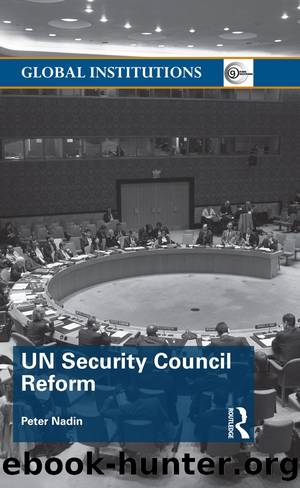
UN Security Council Reform by Peter Nadin
Author:Peter Nadin [Nadin, Peter]
Language: eng
Format: epub
Tags: International Relations, General, Political Science, NGOs (Non-Governmental Organizations), Treaties
ISBN: 9781138920224
Google: P2SaCwAAQBAJ
Goodreads: 26537358
Publisher: Routledge
Published: 2016-03-07T00:00:00+00:00
Power and power projection
The fourth argument follows that by granting permanency to those that are currently powerful, the councilâs agency and authority will be markedly enhanced. In simple terms, including the powerful on the council will make it more powerful.
Power
The council was founded the idea that the strong âadult nationsâ would act in concert to impose on their collective will on the âminor childrenâ and the untrustworthy.12 Together the powerful concert of four (later five) would police the world and enforce disarmament. The naïve assumption of the âun-selfish serviceâ13 of the great powers, coupled with a paternalistic vision of an interventionist cadre of policemen, undermined the practical functioning of the council. Sir Brian Urquhart explains the system and its logic:
It was a pragmatic system based on the primacy of the strongâa âtrusteeship of the powerful,â as he then called it, or, as he put it later, âthe Four Policemen.â The concept was, as Vandenberg noted in his diary in April 1944, âanything but a wild-eyed internationalist dream of a world state. ⦠It is based virtually on a four-power alliance.â Eventually this proved to be both the potential strength and the actual weakness of the future UN, an organization theoretically based on a concert of great powers whose own mutual hostility, as it turned out, was itself the greatest potential threat to world peace.14
Without the presence of the great powers, the council would almost be devoid of manifest influence. Each of the permanent members exerts considerable influence outside the domain of the council. When acting in concert, through the council, the P-5 bid to exercise their collective influence. In this way, the council can be viewed as a receptacle for the collective influence of the five. The calculations of states are clearly shaped by the council, when the permanent membership chooses to act in unity. A diplomatic signal sent via a Chapter VII resolution may only constitute words on paper, but these words are potentially backed by war, force of arms, the threat of force, or the threat or imposition of economic sanctions. The councilâs power is prefaced, in part, on its readiness to use force in the event of non-compliance. The case of Libya in 2011 is one such example. For Muammar Gaddafi, a failure to comply with the demands of the council for âan immediate end to the violence and calls for steps to fulfil the legitimate demands of the populationâ15 led to the imposition of a no-fly zone and the authorization of the use of force. In the first instance, the councilâs demands were backed by sanctions and an ICC referral (resolution 1970), and then later by the use of force (resolution 1973). In this case, Gaddafi underestimated the resolve of council.
If the council displays a reticence to follow through on threats, then its influence is weakened. In this regard, resolve or timidity are directly linked to the unity of the permanent membership. In the case of Darfur, China possessed the greatest capacity to leverage the Government
Download
This site does not store any files on its server. We only index and link to content provided by other sites. Please contact the content providers to delete copyright contents if any and email us, we'll remove relevant links or contents immediately.
| Arms Control | Diplomacy |
| Security | Trades & Tariffs |
| Treaties | African |
| Asian | Australian & Oceanian |
| Canadian | Caribbean & Latin American |
| European | Middle Eastern |
| Russian & Former Soviet Union |
The Secret History by Donna Tartt(19088)
The Social Justice Warrior Handbook by Lisa De Pasquale(12190)
Thirteen Reasons Why by Jay Asher(8909)
This Is How You Lose Her by Junot Diaz(6886)
Weapons of Math Destruction by Cathy O'Neil(6279)
Zero to One by Peter Thiel(5801)
Beartown by Fredrik Backman(5754)
The Myth of the Strong Leader by Archie Brown(5507)
The Fire Next Time by James Baldwin(5444)
How Democracies Die by Steven Levitsky & Daniel Ziblatt(5218)
Promise Me, Dad by Joe Biden(5153)
Stone's Rules by Roger Stone(5087)
A Higher Loyalty: Truth, Lies, and Leadership by James Comey(4962)
100 Deadly Skills by Clint Emerson(4925)
Rise and Kill First by Ronen Bergman(4788)
Secrecy World by Jake Bernstein(4753)
The David Icke Guide to the Global Conspiracy (and how to end it) by David Icke(4717)
The Farm by Tom Rob Smith(4507)
The Doomsday Machine by Daniel Ellsberg(4490)
